Blog
How To Tell & Sell Your Story
- Blog,
Session Overview
Indiana’s innovation economy is stepping into a pivotal year. Venture markets are recalibrating. Artificial intelligence is reshaping entire business models. Capital is available, but it is more disciplined. For founders across the state, the question is not simply whether their product works. It is whether they can clearly articulate why it matters right now.
That was the focus of Elevate Ventures’ Storytelling Workshop, part of our 2026 workshop series designed to equip founders with practical tools they can immediately apply in the market. This session centered on one essential capability: the ability to tell and sell your story in a way that resonates with investors, customers, and partners.
The session was led by Kolby Tallentire, Principal Product Marketer at Innovatemap, a strategy and design firm headquartered in Indianapolis that partners with high-growth startups and scaleups across the country. Innovatemap works at the intersection of positioning, messaging, design, and product strategy. Their expertise is especially relevant as founders prepare for fundraising in 2026, where clarity, differentiation, and credibility are more important than ever.
The tension explored throughout the session was clear. Founders often believe the product will speak for itself. In today’s environment, it will not. The market rewards founders who can connect problem, timing, and traction into a coherent narrative that builds conviction.
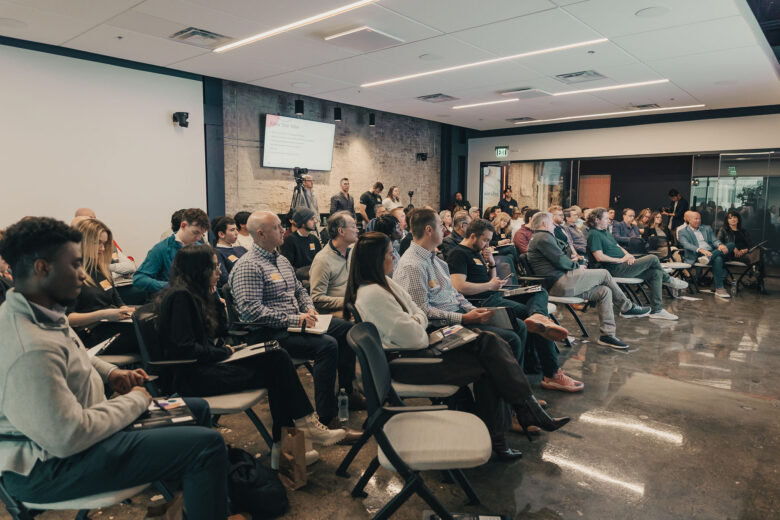
Photo by G. Marie Photography
Session Narrative
Innovatemap began by reframing storytelling as strategic positioning. A pitch is not a script to memorize. It is a structured argument that aligns a problem, a customer, and a solution in a way that makes investment feel logical.
The team emphasized that most founders make one of two mistakes. They either start too high level, citing macro trends without grounding the story in a specific customer, or they dive too deep into features without clearly defining the problem. The result is confusion. Investors are left asking, who is this for and why now?
One of the core ideas shared during the session was the importance of anchoring the story in urgency. Founders were challenged to answer a simple but powerful question: why is this problem important to solve today? In a capital-constrained environment, urgency drives action. Relevance alone is not enough.
During a live pitch segment, three founders presented their companies and received real-time feedback from Innovatemap and Elevate Ventures. The feedback revealed consistent themes that apply to nearly every startup.
First, lead with proof. When one founder saved traction for the end of the presentation, the room responded immediately. Validation changes how a story is received. If customers are already paying, that should shape the entire narrative from the first slide.
Second, clarify the buyer. Large market sizes and industry trends are important, but they do not replace a clear explanation of who is writing the check. Investors are evaluating not only the opportunity, but also the path to revenue.
Third, distinguish vision from reality. Early-stage founders often blend roadmap and current capabilities. The panel encouraged transparency. Be explicit about what exists today, what is being built, and what has been validated. In 2026, disciplined capital favors credible execution over ambition alone.
Innovatemap also addressed the evolving role of AI in storytelling. As generative tools become more common, it is easier than ever to produce polished language. But polish is not differentiation. Founders were reminded that authentic perspective, domain expertise, and lived insight are strategic assets. A compelling narrative reflects the founder’s unique understanding of the problem.
The broader message was that storytelling is not cosmetic. It is operational. A strong narrative shortens sales cycles, increases investor confidence, and aligns internal teams around a shared vision.
For Indiana founders, this clarity is particularly important. The state’s innovation ecosystem spans life sciences, hardtech, manufacturing, and B2B software. Each sector is influenced by macro forces such as workforce shifts, supply chain transformation, healthcare access, and AI adoption. Founders who can connect their company’s mission to these larger economic drivers will stand out in competitive markets.

Photo by G. Marie Photography
Key Takeaways
Anchor your story in urgency. Investors are not just evaluating opportunity. They are evaluating timing. Clearly articulate why this problem must be solved now and what has changed in the market to make this moment decisive.
Define the buyer with precision. Market size is compelling, but specificity builds trust. Identify who pays, what pain they feel, and how your solution changes their economics or operations.
Lead with traction when you have it. Early revenue, pilots, or signed contracts reshape the entire narrative. Validation should frame the story, not close it.
Separate vision from current reality. Be transparent about what exists today versus what is on the roadmap. Credibility in execution is a core signal for venture investors in 2026.
Treat storytelling as infrastructure. Your narrative influences fundraising, hiring, partnerships, and customer acquisition. It is not a marketing exercise. It is a strategic foundation for growth.
Why It Matters
Indiana’s startup ecosystem continues to mature. Over the past decade, the state has seen growth in early-stage capital, sector specialization, and founder support infrastructure. But as capital markets evolve, competition is no longer regional. It is national and global.
In this environment, storytelling becomes a competitive advantage. A clear and credible narrative enables founders to compete for capital beyond state lines, attract top talent, and secure enterprise customers. It also strengthens Indiana’s broader innovation story by demonstrating the depth and quality of companies being built here.
Elevate Ventures exists to accelerate founders at every stage, from ideation to scale. That includes capital investment, venture development, and founder education. Workshops like this one ensure that Indiana entrepreneurs are equipped not only with resources, but with the clarity required to navigate changing markets.
As venture capital grows more selective, disciplined growth, efficient scaling, and strong retention will matter more. The founders who communicate those qualities with precision will be best positioned to lead the next wave of economic growth in the state.

Closing Reflection
Indiana’s innovation economy is built on founders who see opportunity where others see complexity. In a year defined by technological acceleration and shifting capital dynamics, the ability to tell and sell your story is not optional. It is essential.
When Indiana founders combine strong execution with clear, resonant storytelling, they do more than close rounds or win customers. They strengthen the state’s position as a hub for entrepreneurship, talent, and long-term economic growth.
Featured News
-
What 2026 Holds for Innovation, Capital, and Startup Momentum in Indiana
Read More -
Independent Audit Clears Elevate Ventures
Read More -
20 Episodes In: A Trip Down Memory Lane with Innovate or Evaporate
Read More -
The Art Of Resonance
Read More -
Storytelling That Scales: Inside Elevate’s 2026 Workshop Kickoff
Read More -
Economic Outlook for 2026
Read More