Blog
What 2026 Holds for Innovation, Capital, and Startup Momentum in Indiana
- Blog,
Hardtech, software, and advanced industries are expanding rapidly across Indiana. From AI-driven product development to new waves of bioindustrial innovation, the state is entering a moment where entrepreneurship is not only growing but maturing.
To help founders navigate the road ahead, we hosted the 2026 Predictions Workshop, bringing together economists, venture investors, and operators to answer one pressing question: What lies ahead on the other side of the curve?
The conversations were candid. The data was fresh. And the insights pointed toward a year where conditions reward disciplined founders with strong fundamentals and differentiated intellectual property.
Session Overview
Welcome and Framing the Future w/ Toph Day, CEO of Elevate Ventures
In opening remarks, Toph emphasized that Indiana stands at the center of an unfolding productivity boom. The Midwest is emerging as a hub for innovation in bioindustrial technology, manufacturing, and AI-driven product development. Toph set the tone with a clear message: The era of zero-interest rates is gone. Sustainable unit economics and profitability matter more than growth at all costs. The founders who lean into strong fundamentals will have the advantage.
Toph also shared early predictions for 2026. The sticky rate environment is reshaping venture expectations. Intellectual property is emerging as the new capital, particularly as AI commoditizes code. The next era of value creation will emerge from proprietary datasets, domain knowledge, and distribution strength.
AI in 2026 w/ Bret Swanson, Economist and Innovation Strategist
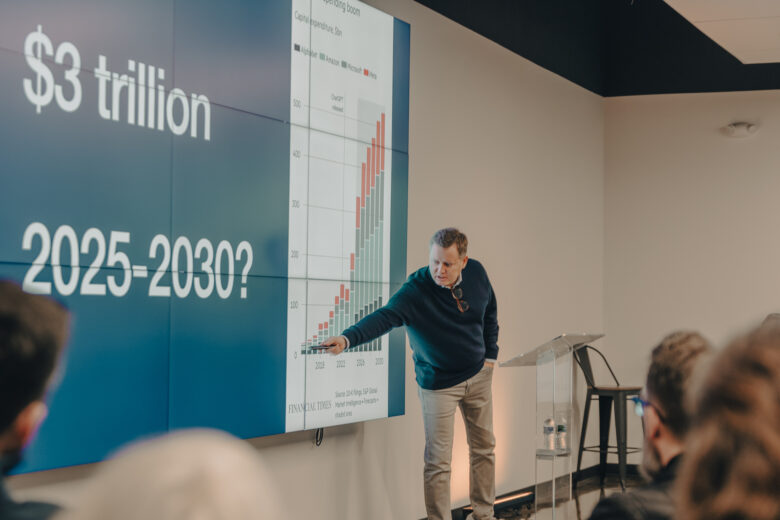
Photo by G. Marie Photography
Bret explained that we are early in what may become the most significant infrastructure buildout in modern history. The internet required approximately $ 3 trillion in investment over three decades. AI is on pace to require the same amount within six years.
He likened today to the late 90s, only amplified. There will be winners, failures, and likely turbulence along the way, but the long arc remains steeply upward. AI is already driving measurable productivity gains in software development. The next frontier is applying those gains to the physical economy: healthcare, manufacturing, logistics, and energy.
Bret noted that productivity growth remains uneven. Digital industries are scaling rapidly, while healthcare and the physical sector lag behind. The opportunity is in closing that gap, which could unlock transformative economic acceleration nationwide. His challenge to the room was simple: Indiana has the industrial capacity, the research institutions, and the talent base to lead this translation.
SaaS Benchmarks and Software Signals w/ Mike Langellier of High Alpha

Photo by G. Marie Photography
Mike presented fresh findings from the 2025 High Alpha SaaS Benchmark Report, now one of the most robust data sources in North America for startup performance. Growth rates have remained healthy across revenue bands, with early-stage companies showing particularly strong upper-quartile acceleration. Events returned as a leading acquisition channel post-COVID, with many startups also experimenting with new pricing models such as hybrid subscription plus usage billing.
Mike highlighted a notable trend: companies are scaling with fewer employees, primarily driven by the adoption of AI in engineering, support, and marketing functions. The companies most likely to raise successfully in 2025 were those with strong net revenue retention and efficient go-to-market models. Fundraising requires more meetings, but deals are still being closed for disciplined teams with clear traction.
Venture Capital in 2026 w/ Myles Grote, Partner at Elevate Ventures
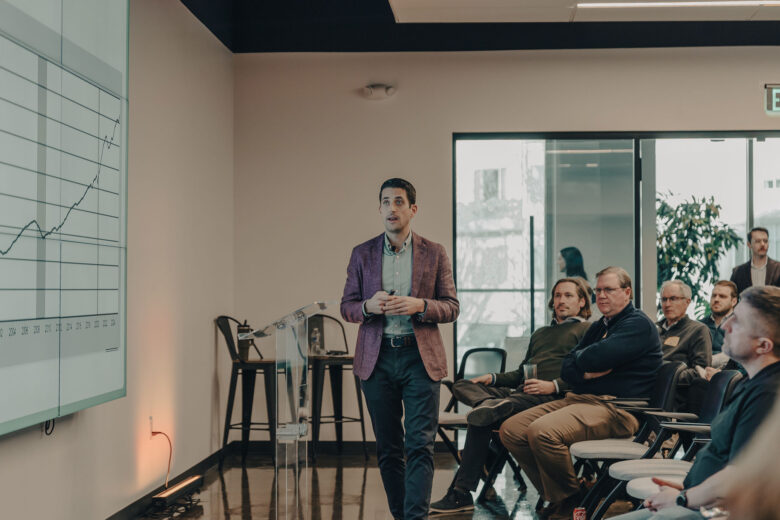
Photo by G. Marie Photography
Myles delivered a macro-to-micro walkthrough of capital markets, touching on interest rates, asset allocation behavior, and the secular cycles that have historically shaped technology adoption. His core belief: the consumer remains the keystone of economic stability, and productivity cycles through AI are reshaping capital velocity rather than suppressing it.
He challenged founders to build in a high-rate environment even as markets gradually unlock. Efficiency is a premium. Burn discipline is non-negotiable. Growth is rewarded only when supported by retention and strong unit economics.
Looking ahead to 2026, Myles expects continued bifurcation between high-quality companies and everything else. Capital will consolidate toward durable businesses with defensible moats, and the Midwest is well-positioned to benefit from industrial modernization.
Fireside Chat with Jim Bullard, Dean, Purdue University; Former President and CEO, Federal Reserve Bank of St. Louis
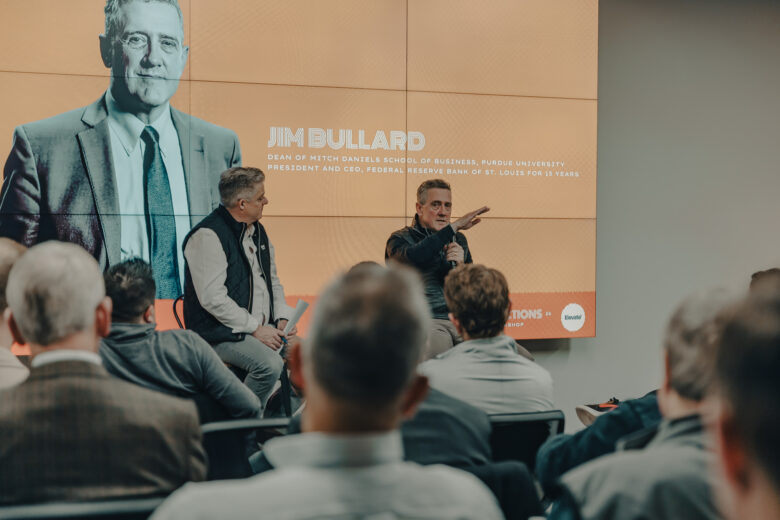
Photo by G. Marie Photography
In the final discussion of the day, Jim provided a grounded perspective on macroeconomic conditions. Despite persistent concerns, the U.S. economy remains resilient, and innovation is a critical driver of that stability. He pointed to demographic shifts, energy demand, and productivity as long-horizon variables that will influence capital formation over the next decade.
Bullard emphasized that innovation does not follow linear curves. Breakthroughs arrive unevenly, and the alignment of policy, infrastructure, and workforce influences how quickly technology realizes its economic value. He reminded founders that periods of uncertainty often precede periods of expansion. For Indiana specifically, he sees strength in manufacturing capability, research universities, and industry adjacency.
Key Takeaways
- AI is still early. The most significant economic impact will come when adoption spreads beyond software into manufacturing, healthcare, logistics, and energy.
- Profitability matters. The growth at all costs era is over. Efficiency, retention, and unit economics determine the durability of valuation.
- IP and data are new differentiators. Commodity code reduces defensibility. Companies must own insights, distribution, and proprietary advantage.
- Fundraising is possible but requires rigor. Most successful rounds in 2025 took 3 to 6 months and required 11 to 50 investor conversations.
- Hybrid pricing models are rising. Blending subscription stability with usage-based expansion is producing stronger net revenue retention.
- AI is shrinking teams. Companies can scale with fewer employees, but execution discipline must increase proportionally.
- Indiana is positioned to lead. Industrial infrastructure, university research, and Midwest manufacturing make the region a prime innovation hub.
- Uncertainty is opportunity. Cycles reward builders with conviction, strategy, and adaptability.
The 2026 Predictions Workshop reinforced a clear message for Indiana founders. The next decade will reward those who understand how to pair emerging technology with real-world problem-solving. As AI accelerates across sectors, industrial states like Indiana stand to benefit. The companies that win will combine technical capability with operational discipline, deep domain understanding, and defensible intellectual property.
Elevate Ventures remains committed to supporting founders through this transition, investing in companies that will define the next cycle of growth. If founders leverage AI intelligently, align capital with discipline, and continue to innovate in sectors that matter for real people, Indiana has the opportunity to lead nationally in productivity, commercialization, and startup creation. The future is not arriving. We are creating it.